Local energy benefits
Building the Future Energy System Locally
The transition to a sustainable energy system is accelerating. As society becomes increasingly electrified, renewable energy generation continues to expand, and expectations for energy security and resilience grow, new approaches are needed to manage how energy is produced, distributed, and consumed.
Energy communities are emerging as a key enabler of this transformation. By allowing citizens, businesses, and property owners to generate, store, share, and manage energy locally, they create opportunities for a more flexible, efficient, and resilient energy system.
This project demonstrates how the coordinated optimization of local energy resources can deliver substantial value to both local communities and the wider energy system. It builds on the experiences and lessons learned from the previous project, System Transformation Through Locally Shared Energy, which explored the technical, economic, legal, and social conditions for energy communities in two Swedish pilot areas.
The project’s ambition is to show how local energy resources can reduce pressure on electricity grids, increase system flexibility, improve resilience, and accelerate the transition to a more sustainable energy future.
Demonstrating Solutions in Two Pilot Areas
The project is carried out in two pioneering energy community developments: Hammarby Sjöstad in Stockholm and Tamarinden in Örebro. Together, these pilots represent both existing urban districts and newly developed neighbourhoods, making the results highly relevant to a large share of Sweden’s building stock.
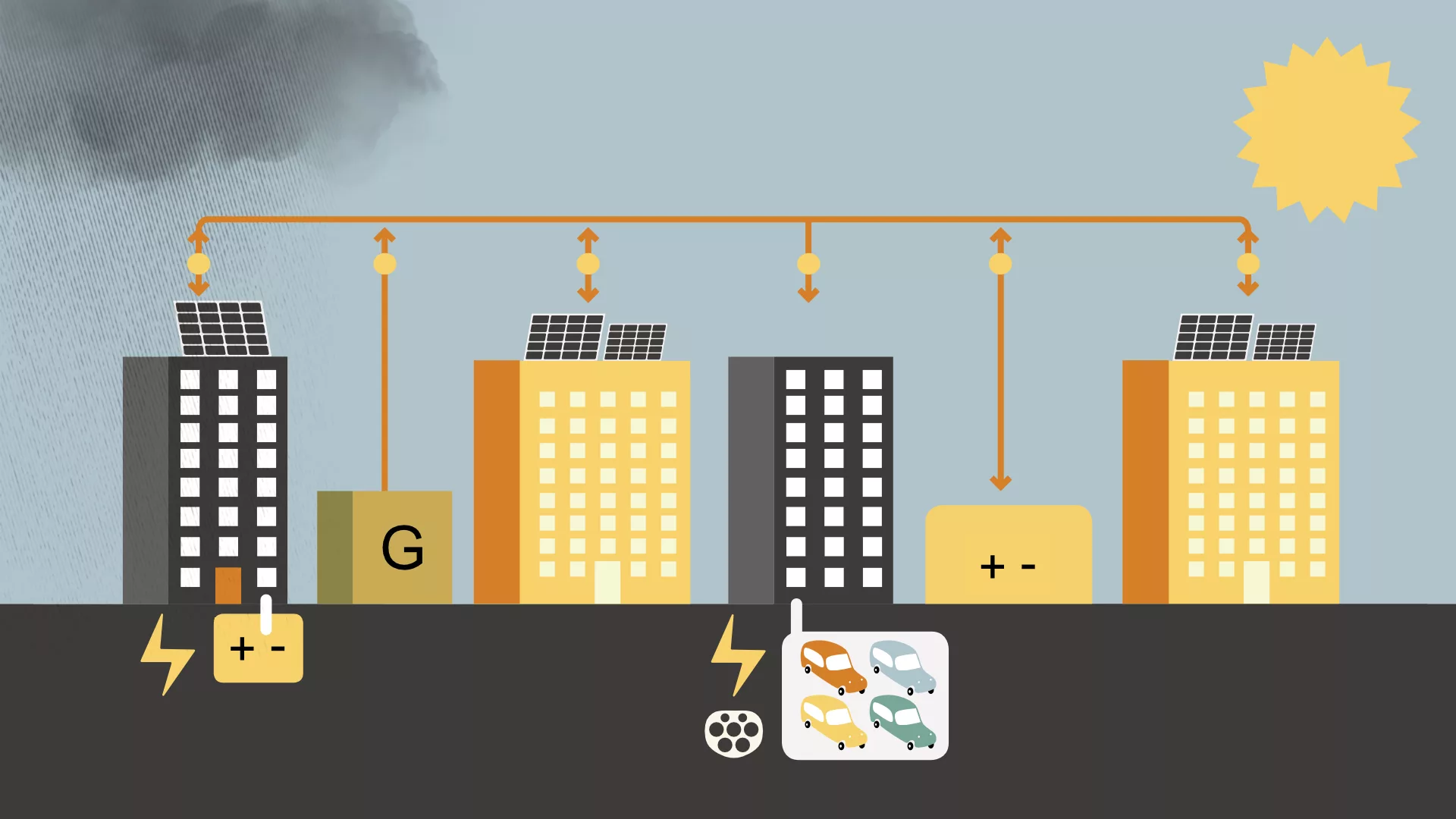
In Hammarby Sjöstad, the focus is on developing an energy community within an established urban environment. Existing buildings are connected through local energy sharing, microgrids, energy storage, and flexibility services. The project demonstrates how residents, housing associations, and property owners can become active participants in the future energy system rather than passive consumers.
AI-driven energy agents will be used to enable more cost-effective coordination and control of distributed energy resources, creating additional value through participation in flexibility markets.
The project will also explore innovative business models and social aspects through Vehicle-to-Building (V2B) electric vehicle sharing schemes located in residential garages. EV batteries will not only support mobility but also provide energy storage for buildings during periods of high demand and serve as valuable flexibility assets for the wider electricity system.
In Tamarinden, energy systems are integrated from the earliest stages of urban planning. Buildings are designed to generate, store, share, and use energy collectively, creating a living demonstration of how future energy communities can operate.
The district serves as a testbed where local solar generation, battery storage, and intelligent energy management work together to reduce peak demand, increase self-consumption of renewable energy, and improve overall system efficiency.
Scalable Solutions for Energy Communities
A key objective of the project is to develop solutions that can be replicated and scaled across Sweden and beyond.
To achieve this, the project is developing digital platforms that automate data collection, communication, optimization, and control across a wide range of energy assets. Through standardized interfaces and seamless digital integration, resources such as solar PV, battery storage, heat pumps, EV charging infrastructure, and other flexible assets can work together as an integrated energy ecosystem.
The goal is to create open, scalable, and interoperable solutions that can be adopted by municipalities, property owners, energy companies, and developers.
Technology alone, however, is not enough. Successful energy communities also require business models that create tangible value for participants.
The project therefore develops and tests market mechanisms and commercial models that reward flexibility, local energy sharing, and coordinated energy use. By aligning economic incentives with system benefits, energy communities can lower energy costs for participants while strengthening the performance of the overall energy system.
Enabling an Inclusive Energy Transition
Energy communities are as much about people as they are about technology.
For this reason, the project investigates social inclusion, citizen engagement, behavioural aspects, and the fair distribution of costs and benefits. Previous research has shown that social acceptance, trust, and effective governance structures are critical to the long-term success of community-based energy solutions.
By understanding and addressing these factors, the project aims to ensure that the energy transition is both inclusive and socially sustainable.
Supporting Future Policy and Regulation
Energy communities remain a relatively new concept, and regulatory frameworks are still evolving to accommodate their full potential.
Through real-world demonstrations and systematic analysis, the project will generate evidence and insights to support future policymaking, regulatory development, procurement strategies, and market design. The lessons learned from the pilot projects will help shape the conditions needed for large-scale deployment of energy communities across Sweden.
Objectives and Expected Impact
The project seeks to develop models that make the energy transition accessible to more people while ensuring that its benefits are shared broadly across society.
Expected outcomes include:
• Increased flexibility and resilience in the energy system.
• Reduced climate impact through more efficient use of renewable energy.
• New business opportunities and markets for local energy services.
• Reduced grid congestion and lower investment needs for network reinforcement.
• Stronger engagement of citizens and local stakeholders in the energy transition.
• Evidence and knowledge to support future energy policy and regulatory development.
The project’s long-term vision is to support the large-scale deployment of energy communities throughout Sweden.
Through collaboration, open demonstration activities, and knowledge sharing, the project will provide valuable insights for municipalities, property owners, utilities, public authorities, policymakers, and other stakeholders.
Ultimately, the project contributes to a more sustainable, resilient, and inclusive energy system—one where local energy resources are utilized more effectively and where the energy transition is driven through collaboration between people, technology, and communities.
Project period
Sep 2025 - Dec 2029
Project info
Categories Digitalization, Energy
Project nameSystem Transformation Through Locally Shared Energy
LocationHammarby Sjöstad
PartnersAmpSociety, Charge Amps, Charge Node, Eghed, Elbilio, ElectriCITY, E.ON, KTC, KTH, LocalLife, ProptechOS, RISE, ViaEuropa, Örebrobostäder, Örebro kommun, Örebroporten Fastigheter
FinancingEnergimyndigheten
Total budgetSEK 58,039,667
Budget ElectriCITYSEK 3,830,400
CoordinatorRISE
Contact persons at ElectriCITY

Partners









Related projects


Digital Energy Communities
Project period
Sep 2025 - Aug 2027
Contacts


Microgrid in Hammarby Sjöstad
Project period
Oct 2021 - Dec 2024
Contacts


RESCHOOL
Project period
Jan 2023 - Jun 2026
Contacts